













If you have flown through Delhi's Terminal 3, Mumbai's Terminal 2, or Bengaluru's Kempegowda International anytime in the last three years, you have undoubtedly witnessed the chaos. Lines stretching hundreds of feet outside the Encalm and Adani lounges, filled with travelers clutching basic, entry-level credit cards. For a brief, golden period in the Indian credit card market, airport lounge access was the ultimate democratized luxury. If you had a bank account and a pulse, you likely had a credit card that promised complimentary food, decent Wi-Fi, and comfortable seating before your flight.
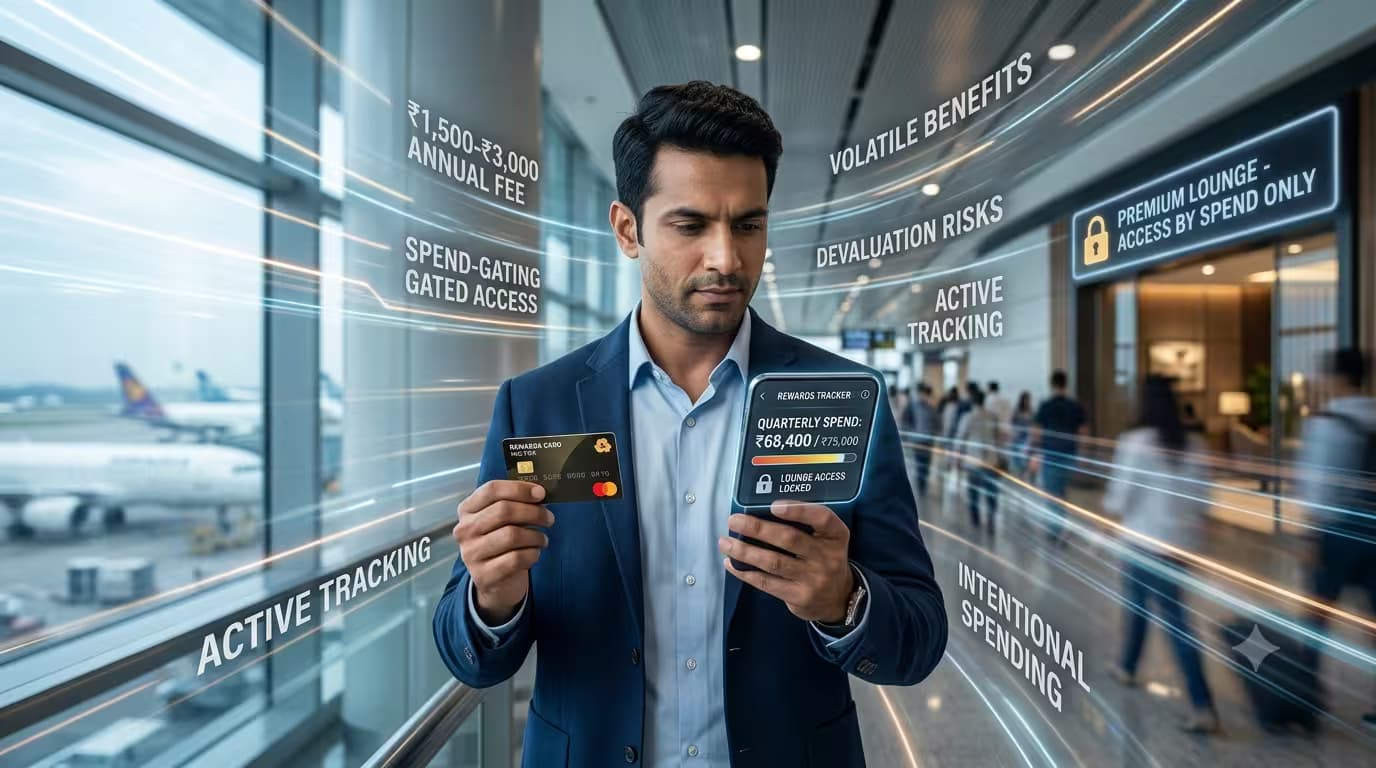
In 2026, that era is definitively and aggressively over. The Indian credit card industry has entered what is now widely known as the "Spend-Gating" era. Major banks and card issuers have abruptly pulled the plug on unconditional, free lounge visits, replacing them with strict, quarter-based spending thresholds. What used to be a standard, expected perk on almost every piece of plastic is now a fiercely protected privilege, reserved strictly for those who put serious transaction volume on their accounts.
Here at CardGuruji, after analyzing the updated terms, conditions, and hidden fine print of over 150 active credit cards across both public and private sector banks, the prevailing trend is undeniable. The free lunch at the airport is over, but for the strategic and organized spender, lounge access is still very much attainable. You simply need to fundamentally change how you approach your daily swipes.
The Economics of the Devaluation: Why Did Banks Pull the Plug?
To understand the solution, you first have to understand the underlying problem that forced the banks' hands. It is a common misconception that banks own the airport lounges. They do not. Banks pay network aggregators like DreamFolks or Priority Pass a flat, non-negotiable fee every single time you swipe your card at the lounge reception desk. Historically, this fee ranged from ₹800 to ₹1,200 per domestic visit, and significantly more for international terminals.
Banks historically subsidized this hefty cost through Merchant Discount Rates (MDR)—the 1% to 2% fee that merchants pay the banks when you swipe your card at a physical store or an online checkout. The math used to work perfectly: a customer would spend ₹50,000 to ₹1,00,000 on lifestyle shopping and groceries, generating enough MDR revenue for the bank to easily cover the cost of a ₹1,000 lounge visit twice a year.
However, the explosion of "Lifetime Free" (LTF) cards completely broke this economic model. The market saw a massive influx of users holding multiple entry-level cards purely for the lounge access, spending close to zero on them throughout the year. Banks were suddenly bleeding money, subsidizing millions of lounge visits for customers who generated absolutely zero MDR revenue. The situation reached a breaking point, leading to the aggressive, industry-wide devaluations we see normalized today in 2026.
The New Rules: A Look at the Spend-Gating Thresholds
The transition from unconditional access to spend-gating has affected almost every major issuer in the country, from HDFC and ICICI to Axis and SBI Card. Instead of asking the outdated question, "Does my card have lounge access?", the only question you must now ask is, "Did I spend enough last quarter to unlock my lounge access for this quarter?"
Here is how the landscape currently looks for some of the most popular mid-tier and premium travel cards in India:
| Credit Card Previous Era Rule 2026 Spend-Gating Rule | ||
| HDFC Diners Club Privilege | Unconditional (2 visits per quarter) | ₹60,000 spend required in the previous calendar quarter |
| Axis Bank Magnus (Burgundy) | Unlimited unconditional domestic access | ₹50,000 spend required in the previous calendar quarter |
| ICICI Sapphiro | ₹5,000 minimal spend requirement | ₹35,000 spend required in the previous calendar quarter |
| SBI Card PRIME | Unconditional (2 visits per quarter) | ₹50,000 spend required in the previous calendar quarter |
| IDFC FIRST Select | ₹20,000 monthly spend | ₹20,000 spend required in the previous calendar month |
It is critical to deeply understand how these calendar quarters work. The quarters are rigidly defined by the banks: Q1 (January-March), Q2 (April-June), Q3 (July-September), and Q4 (October-December). If you have a family vacation flight booked in May (which falls in Q2), your lounge access will depend entirely on whether you crossed the specific spend threshold between January 1st and March 31st (Q1). If you fall short by even one single Rupee, the bank's system will decline the transaction at the lounge counter, and you will be forced to pay out of pocket.
The End of the Physical Swipe: The Rise of Digital Vouchers
Alongside the introduction of spend-gating, banks have initiated a massive crackdown on card-sharing. Previously, you could simply hand your credit card to a family member or a friend traveling on a different flight, and as long as they knew the PIN (or in many tap-to-pay cases, didn't even need one for a ₹2 authentication charge), they could enter the lounge using your quota.
Now, issuers like HDFC and Axis have transitioned away from physical terminal swipes entirely. Once you cross the ₹60,000 threshold, you do not just present your card at the airport anymore. Instead, the bank sends an SMS link or requires you to log into a dedicated portal (such as the DreamFolks web application) to generate a dynamic, time-sensitive QR code. This QR code is strictly non-transferable and is heavily cross-checked against the name printed on your physical boarding pass. This technological shift has effectively killed the grey market practice of lending or renting out credit cards for travel perks.
The Playbook: How to Consistently Hit the Spend Targets
With thresholds hovering around ₹50,000 to ₹75,000 per quarter, casual, unmonitored spending is no longer enough to secure your travel benefits. Hitting these targets requires a deliberate, consolidated approach to your personal finances. Here is the definitive blueprint to ensure you never miss a quarter.
1. Stop the "Split Spend" Sabotage
The single biggest mistake modern Indian credit card users make is holding too many cards and spreading their expenses too thin. If you hold five different credit cards and spread your monthly ₹25,000 household expenses across all of them—perhaps optimizing for 1% extra cashback on an Amazon purchase with one card, or a specific Swiggy discount on another—you will fail to hit the quarterly threshold on any of them.
The fix is simple: Pick one primary travel card and make it your absolute workhorse. Consolidating your spending is the only mathematical way for a middle-class household to consistently hit ₹60,000 a quarter (which breaks down to ₹20,000 a month). You must be willing to sacrifice minor, localized cashback on secondary, entry-level cards to ensure your main travel card clears the high hurdle.
2. Route Utilities Strategically (Even Without Points)
Over the last two years, following strict RBI guidelines, banks have systematically removed reward points and cashback for utility bills, insurance premiums, rent payments, and education fees. However, while these heavy transactions no longer earn you lucrative reward points, they still officially count toward your quarterly spend threshold.
You should immediately route your heavy, predictable expenses through your primary travel card. If you pay a ₹30,000 annual life insurance premium and a ₹3,000 monthly electricity bill, routing these through your target card almost guarantees you will hit your required milestones. It takes the pressure off your discretionary lifestyle spending, ensuring your travel perks remain intact just by paying your mandatory household bills.
3. Weaponize the RuPay-UPI Integration
The integration of RuPay credit cards with the Unified Payments Interface (UPI) has been the biggest game-changer for hitting these new, aggressive spend targets. Previously, credit cards were limited to large purchases at physical Point of Sale (POS) machines or online e-commerce portals. Today, the landscape is entirely different.
If your bank offers a RuPay variant of their travel card, link it to your preferred UPI application immediately. By converting 30 to 40 small, daily UPI cash transactions—such as scanning a QR code for a ₹150 coffee, a ₹300 auto-rickshaw ride, or ₹500 worth of local vegetables—into credit transactions, you can easily add ₹10,000 to ₹15,000 of organic spend to your card every single month. This micro-spend volume, previously lost to savings accounts, is often the exact difference between missing and hitting the quarterly target.
Are Unconditional Lounges Completely Dead?
Not completely, but they have rapidly retreated to the very top of the luxury banking pyramid. If you absolutely refuse to track quarterly spends, hate consolidating your bills, and want the old "swipe and walk in" experience, you will have to upgrade to ultra-premium, high-fee credit cards. Products like the HDFC Infinia, Axis Burgundy Private, and SBI Aurum still offer unconditional, unlimited access (often including comprehensive Priority Pass networks for international travel without any secondary conditions).
However, these elite cards come with massive, unavoidable barriers to entry. They are almost exclusively invite-only, demand steep income requirements (often exceeding ₹35 Lakhs per annum in documented salary), and carry exorbitant annual fees ranging from ₹10,000 to over ₹30,000.
Conclusion: Adapting to the New Reality
For the average consumer holding a standard mid-tier card, paying a ₹1,500 to ₹3,000 annual fee is the norm—and at that specific tier, spend-gating is the unavoidable, permanent reality of the 2026 market. The landscape of credit card benefits will remain highly volatile, with terms and conditions evolving rapidly to keep up with economic pressures. To stay ahead of these devaluations and optimize your wallet, continuous tracking of your reward structures and an active, intentional spending strategy is no longer optional—it is essential for modern travel.