













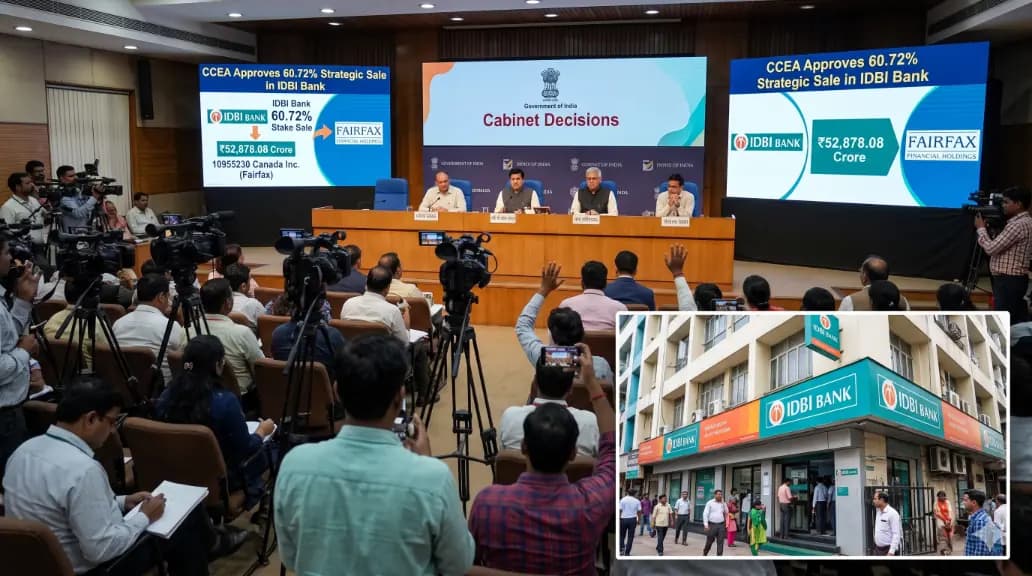
New Delhi, October 2026: A Canadian investment group has moved one step closer to running one of India’s best-known lenders. On October 14, 2026, the Cabinet Committee on Economic Affairs (CCEA) approved 10955230 Canada Inc., an entity backed by Fairfax Financial Holdings, as the strategic buyer of a 60.72% controlling stake in IDBI Bank. The consideration is ₹52,878.08 crore, roughly $5.56 billion.
If completed, the transaction would end a disinvestment process that has run for years and put a privately controlled, foreign-backed owner at the head of a bank that has been under state influence for most of its life.
Who is selling, and what changes
The shares on offer come from the Government of India and Life Insurance Corporation of India (LIC), the bank’s two co-promoters. The government is selling 30.48% and LIC 30.24%. After the sale, the government is expected to hold 15% and LIC 19%, a combined 34% that keeps both institutions on the register as significant minority holders.
Officials have described the deal as the largest foreign direct investment in India’s financial-services sector. Beyond the size, the structure is notable. It is not a minority investment or a financial-sector partnership but a transfer of management control to a foreign-backed buyer.
In summary, the buyer is 10955230 Canada Inc., backed by Fairfax. The stake being sold is 60.72%, valued at ₹52,878.08 crore (about $5.56 billion). CCEA has cleared the deal, while RBI and CCI approvals are still pending.
The price and the market’s reaction
Reports put the transaction price at ₹81 per share. That is above the ₹75.99 benchmark fair value but below where the stock was trading when the approval came. Based on the ₹90.40 close cited in media reports, the price works out to a discount of roughly 10% to 11% to the market.
Investors reacted accordingly. IDBI Bank shares reportedly fell about 7% on October 15. The decline reflects the arithmetic of a control transaction priced under the prevailing market rate more than any verdict on the buyer. Shareholders who bid the stock up in anticipation of a premium have had to reset their expectations, and the 34% that the government and LIC will keep also limits the free float available to other investors.
From development lender to commercial bank
IDBI Bank began as a development finance institution and was later converted into a universal bank. Over the years it accumulated a heavy burden of stressed corporate loans, and ownership eventually settled with the government and LIC. A sale to a strategic investor was meant to give the bank fresh capital, sharper governance and a clearer commercial mandate.
Fairfax, a Toronto-based holding company led by Prem Watsa, is known for long-horizon investing in insurance and financial businesses, often through turnaround situations. Reuters has reported that the group wants to build IDBI into a diversified financial-services business and could fold in some of its existing Indian interests in insurance and related areas. If that happens, IDBI could evolve into a multi-product group rather than remain a conventional lender, though no timeline or structure has been announced.
The CSB Bank complication
The most closely watched unresolved question concerns Fairfax’s roughly 40% holding in CSB Bank. Reserve Bank of India norms generally do not allow a single investor to act as promoter or controlling shareholder of more than one bank. That leaves Fairfax with two broad options: merge CSB Bank into IDBI Bank, or reduce or sell its CSB stake.
A merger would produce a larger platform but would require integrating systems, branches, staff and risk practices, with regulatory sign-offs at every stage. A stake sale would be simpler to execute but would reduce Fairfax’s exposure to a bank it has backed for years. CSB Bank has said it is unaware of any proposed merger with IDBI Bank or of any ongoing discussions on such a transaction. Until Fairfax and the regulators say more, any route is speculation.
What still has to happen
The CCEA nod settles who the buyer is and at what price. It does not complete the sale. Two regulatory clearances remain.
The Reserve Bank of India will examine whether the acquirer meets fit-and-proper criteria, along with promoter, governance and capital requirements. The Competition Commission of India will assess whether the combination raises competition concerns. Both are expected to take the CSB Bank overlap into account.
Neither approval is a formality. Banking regulation in India places heavy weight on ownership transparency and the avoidance of cross-holdings, so conditions or timing changes cannot be ruled out. Until both clear, control does not pass.
Implications for the sector
For policymakers, the deal is a test of the strategic-sale model: find a credible private owner, hand over management control and keep a public stake through the transition. If it works, it could shape how future bank privatisations and consolidations are structured.
For the industry, a foreign-backed controlling owner at IDBI introduces a new kind of competitor. Large private lenders already dominate the most profitable retail and corporate segments, and IDBI’s ability to challenge them will depend on its deposit franchise, technology spending and loan quality rather than its change in ownership alone. Stronger capital and sharper management could help, but they do not remove credit-cycle risk.
What investors and observers should watch
Four points are likely to drive sentiment in the coming months.
First, regulatory timing: any RBI or CCI delay, or any condition attached to approval, could change the schedule or structure.
Second, the CSB Bank decision: a merger, stake sale or restructuring would affect valuations at both banks.
Third, strategy for minority shareholders: a diversified financial-services plan could create value, but capital allocation decisions may not benefit standalone shareholders immediately.
Fourth, early execution: changes in management, asset quality, cost discipline and digital capability will show whether private control improves performance.
Fairfax’s offer and the government’s price have now been formally accepted, but the outcome rests on regulators and on how the new owner handles integration. The ₹52,878-crore commitment will look like a milestone for Indian banking only if the final approvals arrive and the bank’s performance improves afterward.
This article is for information only and is not investment advice. Readers should verify transaction updates, regulatory filings and company disclosures before making decisions. Figures are as supplied in the source material and reported in the media, and have not been independently verified.