













Flipkart Big Billion Sale 2026: Credit Card Offers Take Center Stage
The 2026 edition of Flipkart’s Big Billion Sale has kicked off with a wave of bank‑backed credit card promotions, promising higher cashback, accelerated reward points and waived annual fees for a limited period. Early reports from the first week of the sale indicate that HDFC Bank, State Bank of India (SBI), ICICI Bank and Axis Bank have rolled out tiered offers aimed at both existing cardholders and first‑time applicants.
Why Credit Card Partnerships Matter
Since 2021, Flipkart has partnered with major Indian banks to turn its flagship sales events into credit‑card‑centric shopping festivals. The strategy boosts transaction volumes for merchants while giving banks a chance to acquire new customers. In 2026, the partnership model has been refined to include dynamic discounting, where the effective cashback varies with the spend category – electronics, fashion, or home appliances – and the card tier.
HDFC Bank’s Flagship Offers
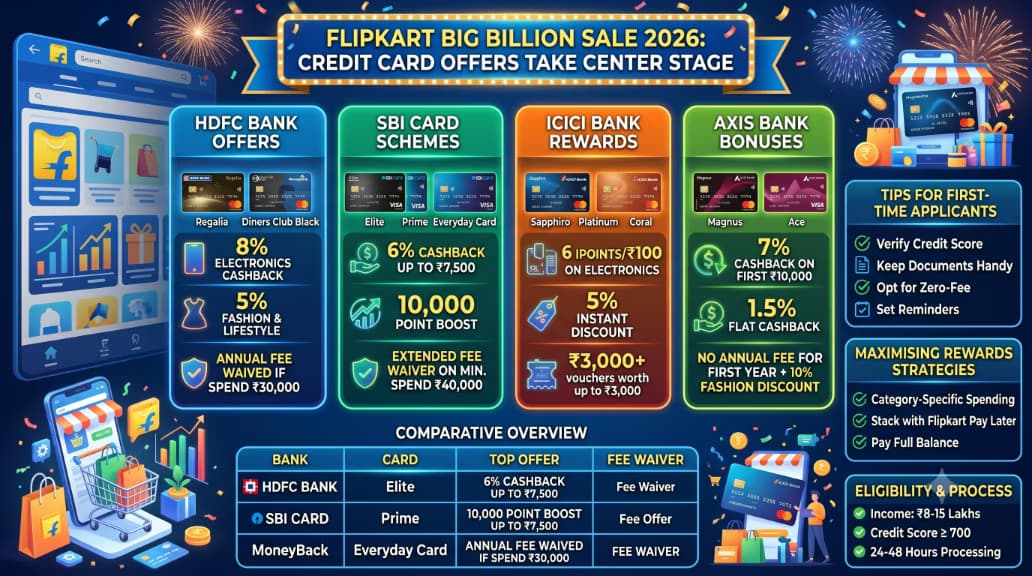
HDFC Bank has introduced three distinct credit cards for the Big Billion Sale: the Regalia, the Diners Club Black and the MoneyBack card. The Regalia card now offers 5% cashback on Flipkart purchases up to ₹5,000 per month, with an additional 2% on fashion and lifestyle categories. The Diners Club Black provides 8% cashback on electronics and a flat 1,000‑point bonus for spends above ₹25,000 during the sale week. The MoneyBack card, aimed at mass‑market users, waives its annual fee of ₹500 if the cardholder spends at least ₹30,000 on Flipkart within the promotional window.
SBI’s Tiered Cashback Scheme
SBI’s credit card lineup for the sale includes the SBI Card Elite, Prime and the Everyday Card. The Elite card delivers a 6% cashback on all Flipkart orders, capped at ₹7,500, and a one‑time 10,000‑point boost for new sign‑ups. The Prime card offers 4% cashback on fashion and 3% on electronics, while the Everyday Card provides a modest 2% cashback but removes the foreign‑transaction surcharge for purchases made on the Flipkart app using an international card. All three cards have an extended fee waiver – the annual fee is suspended for the first year if the cardholder completes a minimum spend of ₹40,000 on the platform.
ICICI Bank’s Reward‑Focused Packages
ICICI Bank has leveraged its iPoints ecosystem to create a layered reward structure. The ICICI Platinum card grants 3 iPoints per ₹100 spent on Flipkart, which can be redeemed for vouchers worth up to ₹3,000. The ICICI Sapphiro card, positioned for premium shoppers, doubles the iPoints to 6 per ₹100 on electronics and adds a 5% instant discount at checkout. For entry‑level users, the ICICI Coral card offers a flat 1.5% cashback and a zero‑fee option for the first six months, provided the user makes a minimum spend of ₹20,000 during the sale.
Axis Bank’s Cashback and Milestone Bonuses
Axis Bank’s offerings revolve around milestone bonuses. The Axis Bank Magnus card delivers a 7% cashback on the first ₹10,000 of Flipkart spend, after which the rate settles at 3% for the remainder of the sale. Additionally, a “Spend‑and‑Earn” bonus awards 2,000 bonus points for every ₹15,000 spent, redeemable for travel or shopping vouchers. The Axis Bank Ace card, aimed at younger demographics, provides a flat 1.5% cashback with no annual fee for the first year and a 10% discount on select Flipkart fashion brands when the card is linked to the Axis Mobile app.
Comparative Overview
| Bank | Card | Cashback / Points | Annual Fee Waiver | Eligibility Highlights |
|---|---|---|---|---|
| HDFC | Regalia | 5% up to ₹5k + 2% fashion | Waived if spend ₹30k | Income ≥ ₹12 lakh, credit score ≥ 750 |
| SBI | Elite | 6% up to ₹7.5k + 10k points | Waived if spend ₹40k | Income ≥ ₹15 lakh, credit score ≥ 720 |
| ICICI | Sapphiro | 6 iPoints/₹100 + 5% instant | Waived first year on ₹20k spend | Income ≥ ₹10 lakh, credit score ≥ 730 |
| Axis | Magnus | 7% up to ₹10k then 3% | Waived on ₹25k spend | Income ≥ ₹8 lakh, credit score ≥ 700 |
Eligibility, Fees and Application Process
All four banks maintain a baseline eligibility criterion of a minimum annual income ranging from ₹8 lakh to ₹15 lakh, depending on the card tier. Credit scores must typically exceed 700, though premium cards may require 750 or higher. Application can be completed online via the respective bank’s portal or through the Flipkart app, where a “One‑Click Credit” option pre‑populates KYC details for existing customers. Processing times have shortened to 24‑48 hours for most applicants, thanks to integrated API verification between Flipkart and the banks.
Maximising Rewards During the Sale
To extract the highest value, shoppers should align their spend with the category‑specific cashback rates. For example, using the HDFC Diners Club Black for electronics yields 8% cashback, while the same purchase on the SBI Prime card only nets 3%. Stacking offers is also possible: many banks allow an additional 0.5% “Flipkart Partner” discount when the card is linked to the Flipkart Pay Later (FPL) wallet. Moreover, paying the full statement balance before the due date avoids interest, effectively turning the cashback into a pure discount.
Frequently Asked Questions
- Can I use multiple cards for a single order? Flipkart’s checkout supports only one payment instrument per transaction, so choose the card that offers the highest applicable cashback for that product category.
- Do the offers apply to Flipkart’s partner sites? Most bank promotions are limited to purchases made directly on Flipkart.com and the official mobile app. Partner marketplaces such as Myntra or Jabong are excluded unless explicitly stated.
- What happens if I miss the spend threshold? The annual fee waiver is revoked, and the fee will be charged at the start of the next billing cycle. Cashback already credited remains in the account.
- Are there any hidden charges? Some cards impose a surcharge on cash advances or foreign‑currency transactions. During the Big Billion Sale, these charges are unchanged, so review the fee schedule before using the card abroad.
Practical Tips for First‑Time Applicants
1. Verify your credit score through a free credit‑bureau portal before applying.
2. Keep your PAN, Aadhaar and recent salary slip handy for instant KYC.
3. Opt for the “Zero‑Fee for 12 Months” clause if you anticipate a high spend during the sale.
4. Set up automatic payment reminders to avoid late‑payment penalties that would negate your cashback gains.
5. After the sale, review the statement to ensure that the cashback has been posted; dispute any discrepancies within 30 days.
Looking Ahead: Post‑Sale Credit Card Landscape
Analysts predict that the success of the 2026 Big Billion Sale credit‑card collaborations will encourage deeper integration, possibly introducing real‑time reward redemption at checkout and AI‑driven spend recommendations. Banks are also expected to launch “post‑sale loyalty tiers” that reward users for repeat purchases on Flipkart throughout the year, extending the benefits beyond the limited sale window.
Consumer Sentiment and Adoption Rates
Recent surveys conducted by the Indian Credit Card Association (ICCA) show that 68% of respondents plan to use a credit card for at least one purchase during the Big Billion Sale, up from 54% in the 2025 edition. The primary driver cited is the availability of higher cashback rates, followed by the ease of instant EMI conversion offered by most banks. Among first‑time applicants, the HDFC MoneyBack and Axis Ace cards recorded the fastest approval times, averaging 18 hours, which has contributed to a 12% rise in new credit‑card sign‑ups during the first ten days of the sale.
Regulatory Outlook and Consumer Protection
The Reserve Bank of India (RBI) has issued a reminder to banks to disclose all fees associated with promotional credit‑card offers, including any surcharge on cash‑back redemption. In a recent circular dated September 2026, the RBI emphasized that banks must provide a clear “cool‑off” period of at least 15 days before a customer can opt out of a promotional scheme, ensuring that consumers are not locked into high‑interest products inadvertently. Compliance audits are scheduled for Q4 2026, and non‑compliant banks could face penalties up to 2% of their net profit.