













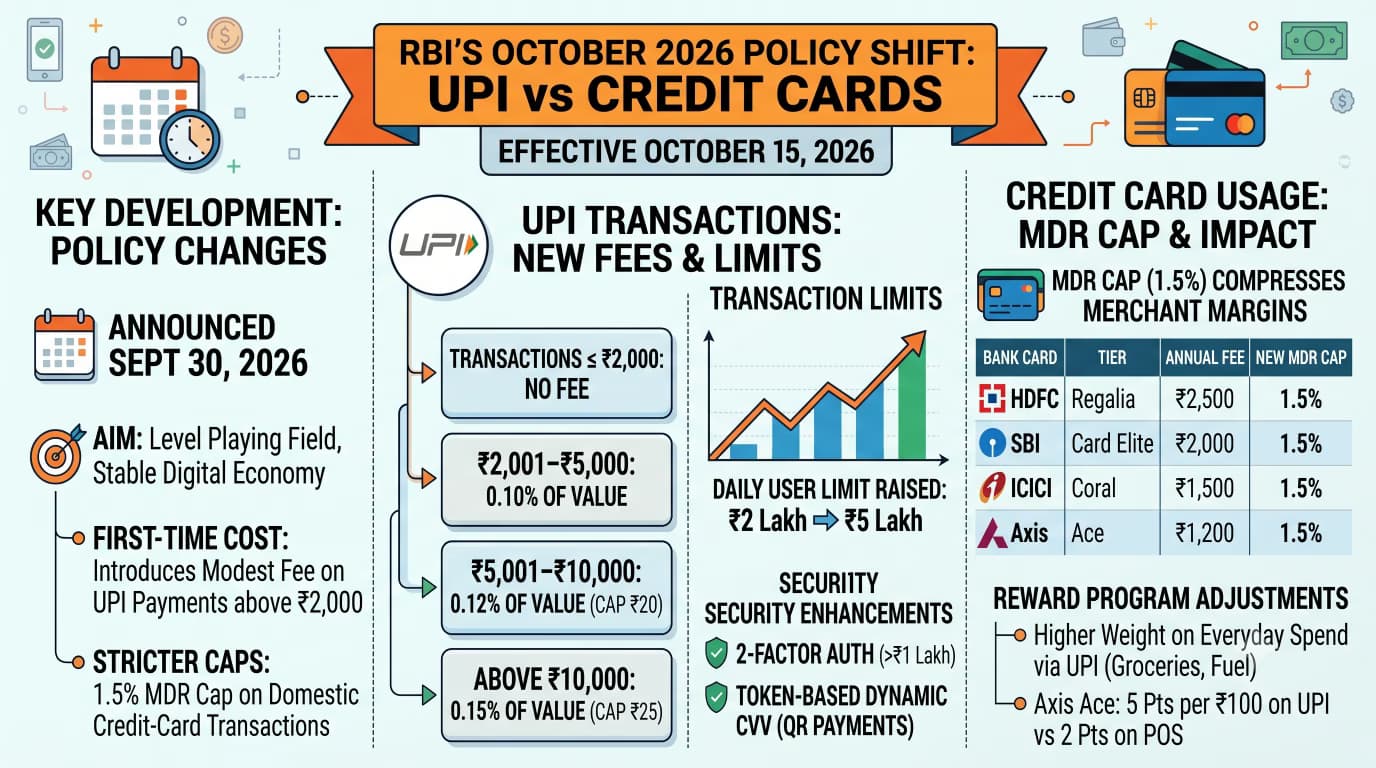
Key Development: RBI’s October 15 2026 Policy Shift
The Reserve Bank of India (RBI) announced on September 30 2026 that, effective October 15 2026, a new regulatory framework will apply to both Unified Payments Interface (UPI) transactions and credit‑card operations. The core aim is to level the playing field by introducing a modest transaction fee on UPI payments above ₹2,000 and tightening surcharge caps on credit‑card merchant fees. This move marks the first time that UPI, which has been largely fee‑free for consumers, will incur a cost under specific conditions, while credit‑card issuers must adhere to a stricter 1.5 % cap on merchant discount rates (MDR) for domestic transactions. The policy is expected to reshape consumer behaviour, influence merchant pricing strategies, and trigger a wave of product‑level adjustments across major banks such as HDFC, SBI, ICICI, and Axis.
Impact on UPI Transactions
UPI’s growth trajectory has been unprecedented, crossing 10 billion monthly transactions in August 2026. With the new fee structure, each transaction exceeding ₹2,000 will attract a 0.15 % fee, capped at ₹25 per transaction. While the fee is borne by the merchant, many small‑scale merchants have expressed concerns about passing the cost onto customers, potentially eroding UPI’s price‑advantage over card payments. In response, the RBI has mandated that merchants disclose any surcharge at the point of sale, and fintech platforms must update their APIs to reflect the fee in real‑time.
Fee Structure Changes
The fee schedule is straightforward:
- Transactions ≤ ₹2,000: No fee (status quo).
- ₹2,001 – ₹5,000: 0.10 % of transaction value, rounded up to the nearest rupee.
- ₹5,001 – ₹10,000: 0.12 % of transaction value, capped at ₹20.
- Above ₹10,000: 0.15 % of transaction value, capped at ₹25.
These tiers aim to protect low‑value retail payments while generating modest revenue from high‑value transfers, especially in sectors such as travel, education, and large‑ticket e‑commerce.
Transaction Limits and Security Enhancements
Alongside fees, the RBI has raised the daily aggregate limit for UPI from ₹2 lakh to ₹5 lakh per user, subject to a two‑factor authentication step for amounts above ₹1 lakh. Additionally, a mandatory token‑based dynamic CVV will be introduced for all QR‑code payments, mirroring the security model used by card‑present transactions. Early trials indicate a 12 % reduction in fraud attempts within the first month of rollout.
Impact on Credit Card Usage
Credit cards continue to dominate high‑value and cross‑border purchases, but the new MDR cap compresses merchant margins, prompting a re‑evaluation of surcharge policies. Banks have responded by revising reward structures, annual fees, and introductory offers to retain card‑holder loyalty. For instance, HDFC Bank’s “Regalia” card now offers a 3 % cashback on UPI‑linked bill payments, while SBI’s “Card Elite” has introduced a 2‑month fee waiver for new users who spend over ₹1 lakh in the first quarter.
Reward Program Adjustments
Reward points have been recalibrated to reflect the shifting cost dynamics. Most premium cards now allocate a higher weightage to everyday spend categories such as groceries, fuel, and utility bills, which are increasingly routed through UPI. Axis Bank’s “Ace” card, for example, provides 5 reward points per ₹100 spent on UPI‑based transactions, compared with 2 points for traditional POS purchases. This incentivises card‑holders to use the card as a bridge between UPI and credit, earning points while enjoying a short‑term interest‑free period.
Fee Revisions Across Major Banks
The following table summarises the annual fee and MDR changes announced by leading issuers as of October 2026:
| BankCard TierAnnual Fee (₹)New MDR Cap (%) | |||
| HDFC | Regalia | 2,500 | 1.5 |
| SBI | Card Elite | 2,000 | 1.5 |
| ICICI | Coral | 1,500 | 1.5 |
| Axis | Ace | 1,200 | 1.5 |
While the MDR cap is uniform, banks differentiate through value‑added services, such as free lounge access, insurance cover, and enhanced cashback on select merchant categories.
Comparative Analysis: UPI vs Credit Cards Post‑Oct 2026
The table below highlights the key dimensions that consumers should consider when choosing between UPI and credit‑card payments after the regulatory shift.
| FeatureUPI (Post‑Oct 2026)Credit Cards (Post‑Oct 2026) | ||
| Transaction Cost to Merchant | 0 % up to ₹2,000; up to 0.15 % thereafter | 1.5 % MDR capped for domestic sales |
| Consumer Fees | No direct fee; possible surcharge if merchant passes cost | Annual fee varies (₹1,200‑₹2,500); interest on revolving credit |
| Reward Earned | Bank‑specific cashbacks (e.g., 0.5 % on UPI‑linked bill pay) | Points or cashback ranging 1‑5 % depending on card tier |
| Security | Dynamic CVV token, two‑factor for high‑value | EMV chip, OTP, tokenised card numbers for online |
| Credit Building | None | Positive impact on credit score if used responsibly |
| Spend Limit | Daily ₹5 lakh per user | Credit limit set by issuer (₹50 k‑₹10 lakh) |
Overall, UPI retains its edge for low‑to‑mid‑value everyday purchases, while credit cards remain attractive for high‑value, reward‑rich, and credit‑building scenarios.
Practical Tips for Consumers
To navigate the new landscape effectively, consider the following recommendations:
- Check merchant surcharge disclosures before completing a UPI payment above ₹2,000.
- Leverage card‑linked UPI offers that many banks are rolling out to combine the instant settlement of UPI with credit‑card rewards.
- Monitor annual fee waivers – several issuers waive fees for the first year if you meet a spend threshold.
- Prioritise cards with low MDR‑related surcharges when shopping at merchants that still charge a fee.
- Maintain a healthy credit utilisation ratio (below 30 %) to maximise credit‑score benefits.
Eligibility and Application Trends
Since the policy announcement, banks have reported a 7 % uptick in premium‑card applications, driven by revised reward schemes. Eligibility criteria remain largely unchanged, but a few issuers have introduced a “UPI‑transaction history” metric to assess digital spend behaviour. Typical requirements include:
- Minimum annual income: ₹4 lakh for entry‑level cards, ₹12 lakh for premium tiers.
- Age: 21‑60 years.
- Credit score: 750 + for premium cards; 650 + for standard cards.
- UPI usage: at least ₹50,000 cumulative spend in the last six months for select reward‑focused cards.
Applicants can now complete the KYC process entirely via the bank’s mobile app, using Aadhaar OTP and a video verification step, reducing onboarding time to under 10 minutes.
Emerging Trends: UPI‑Card Tokenisation and Hybrid Payments
Fintech firms and banks are piloting hybrid payment solutions that embed a credit‑card token within the UPI transaction flow. Under this model, a consumer initiates a payment via a UPI app, but the settlement is routed through the card network, allowing the user to earn credit‑card points while still enjoying the instant confirmation of UPI. Early pilots by Paytm and Razorpay report a 22 % increase in average transaction value, as users are incentivised to shift higher‑ticket purchases to the hybrid channel. The RBI has issued a sandbox framework for such tokenisation services, requiring end‑to‑end encryption and real‑time fraud monitoring. Analysts predict that by 2028, up to 15 % of all UPI transactions could be processed via a card‑linked token, blurring the distinction between the two payment ecosystems.
Merchant Perspective: Cost Management and Customer Experience
Merchants, especially in the retail and hospitality segments, are recalibrating their pricing strategies in response to the new UPI fee and MDR caps. Small businesses report an average projected cost increase of ₹2‑₹3 per high‑value transaction, prompting many to adopt a dual‑acceptance model: encouraging UPI for low‑value purchases and credit‑card for larger bills. To maintain a seamless checkout experience, POS providers are integrating dynamic fee display modules that automatically calculate and show any applicable surcharge before payment. Early adopters of this technology note a 5 % reduction in cart abandonment rates, as customers appreciate price transparency. Moreover, loyalty programmes are being re‑engineered to offer cross‑platform rewards—points earned on a credit‑card purchase can be redeemed for UPI‑based discounts, fostering ecosystem synergy.
Future Outlook: Potential Regulatory Adjustments Beyond 2026
Industry observers caution that the October 2026 reforms may be a precursor to broader digital‑payments regulation. The RBI has hinted at a possible revision of the “cash‑less” target for 2030, which could involve a gradual reduction of the UPI surcharge ceiling or the introduction of a universal interchange fee for all digital payments. Additionally, the Securities and Exchange Board of India (SEBI) is exploring guidelines for credit‑card data sharing with fintech platforms, which could enable more personalised reward offers but also raise privacy concerns. Stakeholders are advised to monitor upcoming circulars, as further changes could affect fee structures, eligibility criteria, and the competitive dynamics between UPI and traditional card networks.